
Do AirPods Cause Ear Wax Buildup?
You take an AirPod out and the ear feels stuffed. The evidence pulls in two directions.
On one side sit the reference texts. The standard clinical reference on wax removal states that frequently putting things into the ear canal — swabs, some hearing aids, earbuds — “often accelerates cerumen production,” and that impaction is often seen in people who routinely wear hearing aids or earplugs.[1] The national earwax guideline also places device wearers at increased risk, without attaching a figure to it.[5] Both are expert opinion rather than measurement.
Against that sit the studies. The one that tested the question directly compared 46 patients, 30 of them earphone users, and found no difference in how often they cleaned their ears or sought professional wax removal.[2] A survey of 50 users did report wax accumulation among the effects they noticed, but it asked rather than examined, and had no non-users to compare against.[9]
What the two sides disagree about is method. Nobody has looked into the ears of earbud wearers and non-wearers and counted the wax. The studies measure proxies instead — cleaning habits, remembered symptoms — and proxies disagree. A 2024 paper meant to settle the question turned out to be a protocol, and no results have followed.
Unproven, then, rather than disproven.
| What you have heard | What the evidence shows | Verdict |
|---|---|---|
| Earbuds make you produce more wax | A clinical reference says so. No study has measured it.[1] | Plausible, unmeasured |
| Earbuds block the ear’s self-cleaning conveyor | The conveyor is real and its speed measured — never with a device in place.[6] | Untested |
| Earbuds are why my ear feels blocked | Sealing the canal raises the level of your own body’s sounds by up to 30 dB.[3] | Well established |
| Earbuds cause ear infections | 1 in 5 users report a past outer-ear infection, but there was no comparison group.[7] | Associated, not proven |
| A cotton swab clears it out | The guideline advises against it and reports more wax in swabbed ears.[5] | Counterproductive |
The quickest way past this is to have someone look. No referral, no insurance to check, and same-day appointments are usually available. CERA Ear Clinic examines the canal and eardrum under a surgical microscope in River West, and you watch on the screen. Book online in about 60 seconds.
Then why does the ear feel blocked?
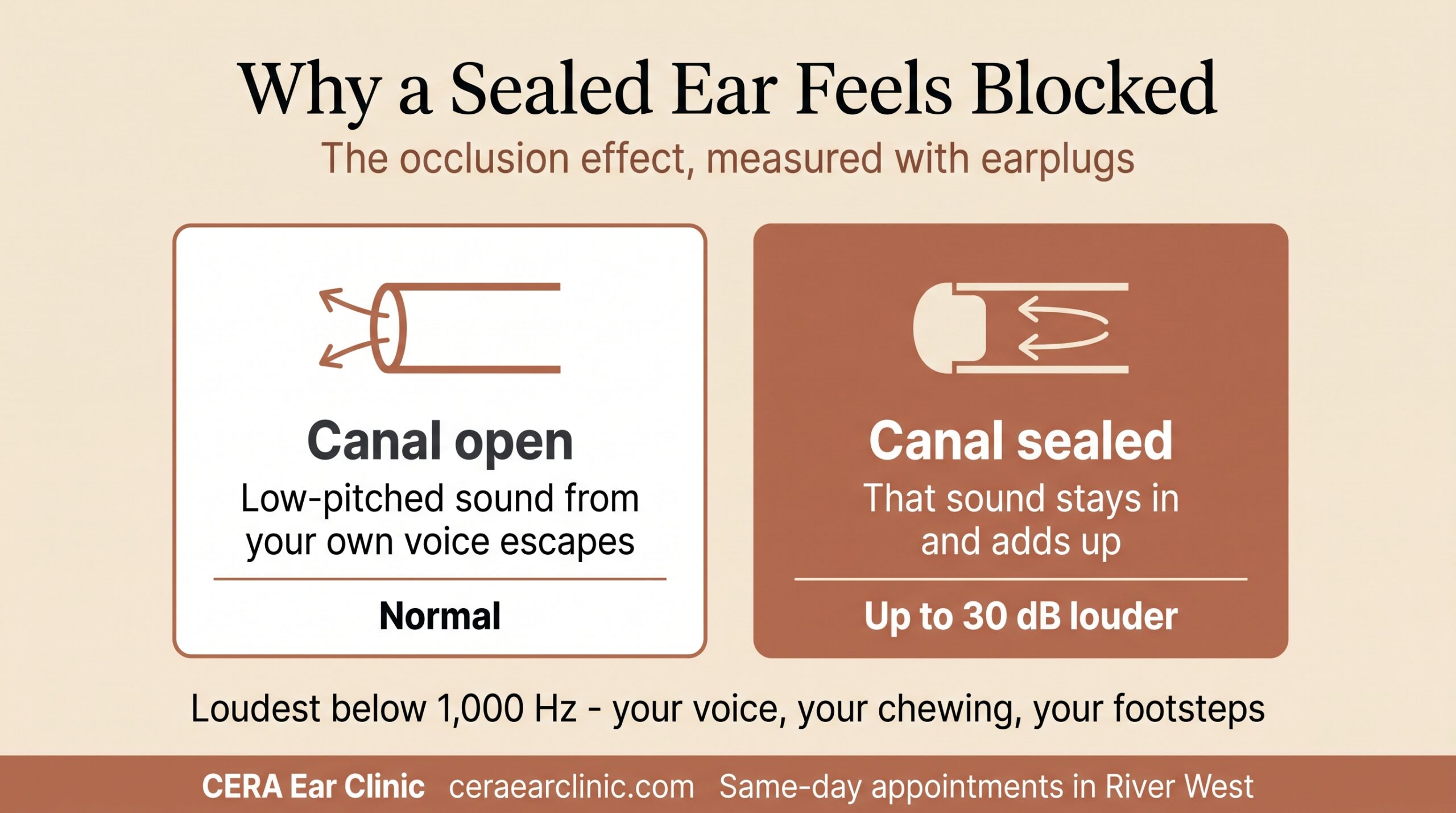
Because you sealed it. The occlusion effect is the rise in sound pressure inside a closed ear canal. Your voice, chewing and footsteps reach your ear through the bone of your skull as well as through the air. With the canal open, most of that low-pitched energy escapes; plug the canal and it stays. Measured with foam and silicone earplugs, the effect runs from roughly 30 decibels at the lowest pitches down to about 10, all below 1,000 hertz.[3] It has since been measured in hearables, the category earbuds belong to.[4]
Thirty decibels is not subtle, which is why your voice sounds like it is inside your head on a call. It is a sound effect rather than an obstruction. Take the device out and the level drops back.
Does it matter which earbuds?
Only in whether they seal the canal. A silicone or foam tip pushed inside produces the occlusion effect; a bud resting in the bowl of the outer ear largely does not. Fit depth works the opposite way to most people’s expectation: a deeper, snugger fit produces less of the effect, not more.[3]
How does the ear clean itself?
It moves. Ear wax, or cerumen, is made continuously in the outer ear canal, and the skin lining that canal migrates slowly outward, carrying the wax with it. Ordinary jaw movement helps it along.[5] A review of ten studies put the rate at about 145 micrometers a day[6] — a millimeter a week, so a conveyor belt but not a fast one. Whether a device slows that belt has never been measured either. In our own practice it is hearing aid wearers who need clearing most often.
What actually helps?
Not much, and none of it means wearing them less than you want to.
- Give the ear some open time. No earbud study sits behind this, but hearing aid wearers are told to leave the device out for eight hours a day to reduce buildup.[1]
- Wipe the tips, keep them dry, and keep them yours.
- Leave the canal alone. Objects pushed in drive wax deeper, and the guideline is explicit that patients “should be counseled not to insert any foreign objects into the ear canal.”[5]
When is it not the earbuds?
When the symptoms persist despite taking the earbuds out. A blocked ear is one of the least specific complaints in ear medicine. Wax causes it, and so does fluid behind the eardrum. So does eustachian tube dysfunction, where the tube that equalizes pressure stops managing the job, bringing fullness, popping and muffled hearing.[8] Fullness that lasts for days, or sits in one ear only, is worth having examined. Two things need attention sooner than a routine appointment:
- Sudden hearing loss in one ear is a medical emergency, not wax, and the treatment window is measured in days. Seek same-day care rather than booking a cleaning.
- Ear pain, drainage or bleeding should be looked at before any cleaning happens.
What the feeling cannot tell you
No sensation separates a sealed canal from one packed with wax, or either of those from fluid behind the eardrum. They all read as blocked, so the answer is not a better description of the feeling. It is a look. At CERA that means a binocular microscope of the type used in ear surgery, with the view on a screen so you can watch. Sometimes there is a plug and it lifts out under fine suction in minutes; sometimes the canal is clear, which is an answer too. Here is the full walkthrough, and more on how ears look after themselves.
This article is for general information and does not constitute medical advice or replace an examination by a qualified clinician. Seek urgent medical attention for sudden hearing loss, severe ear pain, or bleeding from the ear.
References
- Sevy JO, Hohman MH, Singh A. Cerumen impaction removal. StatPearls. Updated March 1, 2023.
- Çam OH. The effects of earphone usage on ear wax (cerumen) impaction. Northwestern Medical Journal. 2021;1(2):48–52.
- Carillo K, Sgard F, Dazel O, Doutres O. Reduction of the occlusion effect induced by earplugs using quasi perfect broadband absorption. Scientific Reports. 2022;12:15336.
- Blau M, Roden R, Hauenschild N, et al. Methods to experimentally characterize the own-voice-generated objective occlusion effect induced by hearables. Acta Acustica. 2025;9:73.
- Schwartz SR, Magit AE, Rosenfeld RM, et al. Clinical practice guideline (update): earwax (cerumen impaction). Otolaryngology–Head and Neck Surgery. 2017;156(1_suppl):S1–S29.
- Saniasiaya J, Prepageran N. The rate and pattern of otic epithelial migration: systematic review. The Journal of Laryngology & Otology. 2022;136(10):892–897.
- Kim GY, Jo M, Cho YS, Moon IJ. Ear symptoms and earphone usage: a web-based survey study. Journal of Audiology & Otology. 2025;29(2):103–109.
- Hamrang-Yousefi S, Ng J, Andaloro C. Eustachian tube dysfunction. StatPearls. Updated February 13, 2023.
- Alkhalifah A, Mohammed AH, Alswoailem NA, et al. Earphone use habits and their association with auditory and dermatologic complications. Scientific Reports. 2025;15:41848.