@import url('https://fonts.googleapis.com/css2?family=Montserrat:wght@300;400;500;600;700&display=swap'); /* Roxborough CF Font */ @font-face { font-family: 'Roxborough CF'; src: url('https://use.typekit.net/af/1b5f76/00000000000000007735e609/30/l?primer=7cdcb44be4a7db8877ffa5c0007b8dd865b3bbc383831fe2ea177f62257a9191&fvd=n4&v=3') format('woff2'); font-weight: 400; font-style: normal; } .cera-blog-post { background-color: #e9decc; font-family: 'Montserrat', -apple-system, BlinkMacSystemFont, 'Segoe UI', sans-serif; color: #333; line-height: 1.7; font-size: 16px; } .cera-blog-post h1, .cera-blog-post h2, .cera-blog-post h3, .cera-blog-post h4 { font-family: 'Roxborough CF', Georgia, serif; color: #515056; margin-top: 2.5em; margin-bottom: 0.75em; font-weight: 400; } .cera-blog-post h1 { font-size: 2.5em; margin-top: 0; margin-bottom: 0.5em; line-height: 1.2; } .cera-blog-post .meta-info { font-style: italic; font-size: 0.95em; color: #666; margin-bottom: 2.5em; } .cera-blog-post h2 { font-size: 2em; border-bottom: 2px solid #a77257; padding-bottom: 0.4em; margin-top: 2.5em; } .cera-blog-post h3 { font-size: 1.5em; color: #a77257; margin-top: 2em; } .cera-blog-post p { margin-bottom: 1.25em; } .cera-blog-post a { color: #a77257; text-decoration: none; border-bottom: 1px solid transparent; transition: border-bottom 0.3s ease; } .cera-blog-post a:hover { border-bottom: 1px solid #a77257; } .cera-blog-post ul, .cera-blog-post ol { margin-left: 1.5em; margin-bottom: 1.25em; } .cera-blog-post li { margin-bottom: 0.6em; } .cera-blog-post strong { font-weight: 600; color: #515056; } /* Images with Captions */ .cera-blog-post .content-image { width: 100%; height: auto; margin: 2em 0; border-radius: 8px; box-shadow: 0 4px 12px rgba(0, 0, 0, 0.1); } .cera-blog-post .image-caption { font-size: 0.85em; font-style: italic; color: #666; text-align: center; margin-top: -1.5em; margin-bottom: 2em; } /* Info Box (for tips, recommendations, videos) */ .cera-blog-post .info-box { background-color: rgba(167, 114, 87, 0.1); border-left: 4px solid #a77257; padding: 1.5em 2em; margin: 2em 0; border-radius: 4px; } .cera-blog-post .info-box h4 { color: #a77257; margin-top: 0; margin-bottom: 1em; font-size: 1.1em; } /* Warning Box (orange for cautions) */ .cera-blog-post .warning-box { background-color: rgba(255, 200, 87, 0.15); border-left: 4px solid #ff9800; padding: 1.5em 2em; margin: 2em 0; border-radius: 4px; } .cera-blog-post .warning-box h4 { color: #ff9800; margin-top: 0; margin-bottom: 1em; font-size: 1.1em; } /* Inline CTA Box */ .cera-blog-post .cta-box { background-color: rgba(167, 114, 87, 0.1); border-left: 4px solid #a77257; padding: 1.5em 2em; margin: 2em 0; border-radius: 4px; } /* Styled CTA Box (gradient, for end of article) */ .cera-blog-post .cta-box-styled { background: linear-gradient(135deg, #a77257 0%, #8b5e47 100%); color: white; padding: 2.5em 2em; margin: 2.5em 0; border-radius: 8px; text-align: center; box-shadow: 0 6px 20px rgba(167, 114, 87, 0.3); } .cera-blog-post .cta-box-styled h3 { color: white; margin-top: 0; margin-bottom: 0.75em; font-size: 1.8em; } .cera-blog-post .cta-box-styled p { margin-bottom: 1.5em; font-size: 1.1em; color: white; } .cera-blog-post .btn-book { display: inline-block; background-color: white; color: #a77257; padding: 1em 2.5em; border-radius: 30px; font-weight: 600; text-decoration: none; transition: transform 0.3s ease, box-shadow 0.3s ease; border: none; margin: 0.5em; } .cera-blog-post .btn-book:hover { transform: translateY(-2px); box-shadow: 0 8px 20px rgba(0, 0, 0, 0.15); border-bottom: none; } /* Key Statistics */ .cera-blog-post .key-stat { font-size: 1.1em; background-color: #a77257; color: #ffffff; padding: 0.2em 0.5em; border-radius: 4px; } /* Tables (improved with shadow and rounded corners) */ .cera-blog-post table { width: 100%; border-collapse: collapse; margin: 2em 0; background-color: white; box-shadow: 0 2px 8px rgba(0, 0, 0, 0.05); border-radius: 8px; overflow: hidden; } .cera-blog-post th { background-color: #a77257; color: white; padding: 1em; text-align: left; font-weight: 600; } .cera-blog-post td { padding: 1em; border-bottom: 1px solid #e9decc; } .cera-blog-post tr:last-child td { border-bottom: none; } /* FAQ Section (card-based design) */ .cera-blog-post .faq-section { margin-top: 2.5em; } .cera-blog-post .faq-item { background-color: white; padding: 1.5em; margin-bottom: 1.5em; border-radius: 6px; box-shadow: 0 2px 6px rgba(0, 0, 0, 0.05); } .cera-blog-post .faq-question { font-family: 'Roxborough CF', Georgia, serif; font-size: 1.2em; color: #515056; margin-bottom: 0.75em; font-weight: 500; } .cera-blog-post .faq-answer { color: #555; line-height: 1.7; } /* References Section */ .cera-blog-post .references { margin-top: 3em; padding-top: 2em; border-top: 2px solid #a77257; } .cera-blog-post .references h2 { border-bottom: none; margin-top: 0; } .cera-blog-post .references ol { margin-left: 1.25em; } .cera-blog-post .references li { margin-bottom: 1em; font-size: 0.95em; } /* Medical Disclaimer */ .cera-blog-post .disclaimer { font-size: 0.9em; color: #666; font-style: italic; border-top: 1px solid #ddd; padding-top: 1.5em; margin-top: 2.5em; } /* Mobile Responsiveness */ @media (max-width: 768px) { .cera-blog-post h1 { font-size: 2em; } .cera-blog-post h2 { font-size: 1.6em; margin-top: 2em; } .cera-blog-post h3 { font-size: 1.3em; } .cera-blog-post table { font-size: 0.9em; } .cera-blog-post th, .cera-blog-post td { padding: 0.75em; } .cera-blog-post .cta-box-styled { padding: 2em 1.5em; } } /* WordPress Theme Integration - Hide duplicate title and set page background */ body, .site, .site-content, .content-area, main, #main, #content, .elementor-section-wrap, .elementor-element { background-color: #e9decc !important; } /* Hide WordPress automatic post title - we use the H1 in the article */ .entry-title, .post-title, .page-title, .single-post-title, article > header h1, .elementor-page-title, .elementor-heading-title.elementor-size-default, h1.entry-title, header.entry-header h1 { display: none !important; } /* Also hide the entry header if it only contains the title */ .entry-header:not(:has(> *:not(h1):not(.entry-title))) { display: none !important; }
Should You Clean Your Ears with Cotton Swabs? The Definitive Guide
Every day, 34 children arrive at emergency rooms across the United States with ear injuries caused by cotton swabs. That statistic comes from a 20-year study published in The Journal of Pediatrics, which documented over 263,000 pediatric cotton swab injuries between 1990 and 2010. Adults fare no better. A recent survey found that 21.4% of cotton swab users report ear discomfort, while 10.5% develop wax impaction and 9.2% experience hearing loss directly from swab use.
The paradox is striking: an item marketed for ear hygiene causes the very problems it claims to prevent. Understanding why requires a closer look at ear anatomy, the biology of cerumen, and what actually works for ear care.
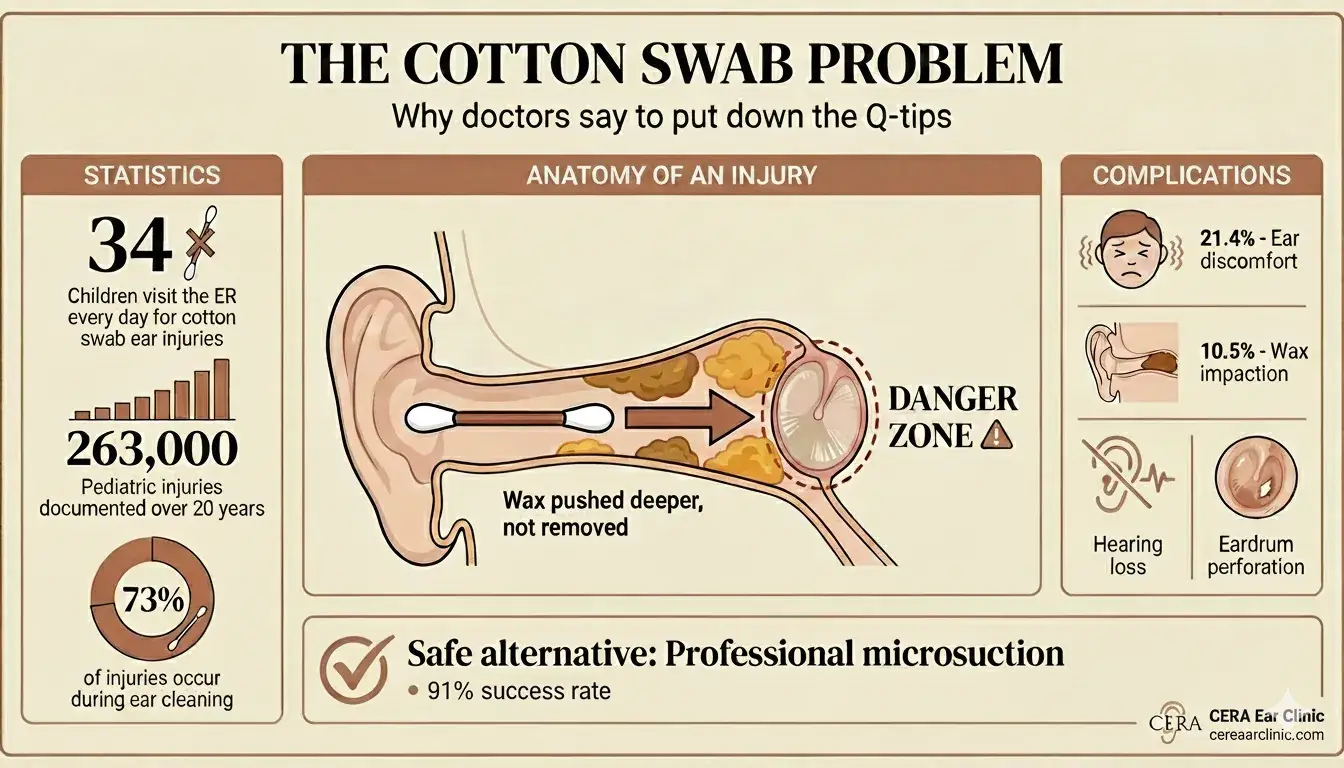
Cotton swab injuries send thousands of Americans to the emergency room every year
The Anatomy Problem: Why Cotton Swabs Don’t Work
The ear canal measures roughly 2.5 centimeters in length and narrows significantly as it approaches the eardrum. A standard cotton swab head spans approximately 1 centimeter in diameter—nearly the width of the canal itself. There’s simply no room to maneuver around earwax. Instead, the swab acts as a plunger, compacting wax against the tympanic membrane with each insertion.
Dr. Kris Jatana, senior author of the Nationwide Children’s Hospital study, describes the mechanism plainly: “The most common thing I see is that by using a cotton swab, the wax is actually pushed further back in the ear canal.” This compaction transforms soft, naturally migrating cerumen into hardened impaction that the ear cannot clear on its own.
The Mayo Clinic confirms this phenomenon: “Earwax blockages often happen when people try to get earwax out on their own by using cotton swabs or other items in their ears. This usually pushes wax deeper into the ear, rather than removing it.”
What Earwax Actually Does
Cerumen isn’t debris—it’s a sophisticated biological secretion that protects your hearing. As we detail in our comprehensive earwax guide, this substance contains antimicrobial fatty acids, maintains an acidic pH of approximately 6.1, and creates a physical barrier against dust, bacteria, and insects.
The ear canal is self-cleaning by design. Epithelial migration—the slow outward movement of skin cells—carries old wax toward the ear opening at a rate of about 0.05mm per day. Jaw movements during talking and chewing assist this process. Cotton swabs disrupt this natural conveyor belt, pushing debris backward into territory the ear cannot clear.
The Injury Spectrum: From Irritation to Permanent Damage
Cotton swab complications exist on a spectrum, and the severity often surprises patients who’ve used them for years without obvious incident.
| Complication | Prevalence | Outcome |
|---|---|---|
| Ear canal abrasion | Common | Pain, bleeding, infection risk |
| Cerumen impaction | 10.5% of users | Hearing loss, fullness, tinnitus |
| Otitis externa | Frequent with repeated use | Painful infection requiring treatment |
| Tympanic membrane perforation | ~1% of ER cases | Immediate hearing loss, surgical repair may be needed |
| Ossicular chain damage | Rare but documented | Permanent conductive hearing loss |
Research from Cedars-Sinai found that in nearly 1,000 emergency room visits studied, cotton swabs were the most common cause of traumatic eardrum perforations. Children under six face the highest risk due to their narrower ear canals and unpredictable movements.
Stop Using Cotton Swabs Immediately If You Experience:
- Sudden pain during or after use
- Bleeding from the ear canal
- Sudden hearing reduction
- Dizziness or ringing in the ears
- Discharge or fluid draining from the ear
These symptoms may indicate eardrum perforation or other injury requiring professional evaluation.
The Impaction Epidemic
Cerumen impaction affects 18.6% of Americans aged 12 and older—and that percentage climbs to 32.4% for adults over 70. One in ten children has impacted earwax, with cotton swab use identified as the primary cause in pediatric cases.
Impaction isn’t merely uncomfortable. The condition causes measurable hearing loss (typically 5-40 decibels), creates a sensation of fullness or pressure, and can trigger tinnitus. In elderly patients, undiagnosed cerumen impaction frequently masquerades as cognitive decline or dementia, with studies documenting dramatic improvements in communication and engagement following wax removal.
The cruel irony: patients who use cotton swabs to address these symptoms typically make them worse, packing wax deeper with each attempt.
Recommended Video: Understanding Ear Wax
For a helpful visual explanation of why cotton swabs don’t work and how the ear naturally cleans itself, we recommend this TED-Ed talk by Henry C. Ou: “What is earwax — and should you get rid of it?” This engaging animated video explains the science behind cerumen production and addresses common misconceptions about ear cleaning.
Safe Ear Care: What Actually Works
Effective ear hygiene starts with understanding what requires intervention and what doesn’t. Most ears need no cleaning beyond wiping the outer ear with a damp cloth after showering.
When to Leave Your Ears Alone
If you’re not experiencing symptoms—no fullness, no hearing changes, no discomfort—your ears are managing themselves. The presence of visible wax at the ear opening is normal and doesn’t require removal. That wax is completing its journey outward and will fall away naturally.
When Professional Removal Is Warranted
Intervention becomes appropriate when cerumen causes symptoms: muffled hearing, aural fullness, earache, itching, or tinnitus. At this point, professional removal is safer and more effective than any home method.
Experiencing blocked ears or muffled hearing? Skip the cotton swabs. Book a professional cleaning at CERA and get same-day relief.
Professional Removal Methods Compared
Not all professional ear cleaning methods are equal. The choice matters significantly for both safety and efficacy.
Microsuction represents the current gold standard. Using a surgical microscope for direct visualization, clinicians apply gentle vacuum suction to remove wax without touching the ear canal walls or eardrum. The technique achieves 91% success rates with a complication rate of just 0.2%.
Irrigation (water syringing) remains common but carries notable drawbacks. The method fails to remove wax in 37% of problematic cases and has a 2.3% complication rate—more than ten times higher than microsuction. Patients with perforated eardrums, ear tubes, or previous ear surgery cannot safely undergo irrigation.
For a detailed comparison of these methods, see our analysis of microsuction versus irrigation.
| Factor | Microsuction | Irrigation |
|---|---|---|
| Success rate | 91-97% | 63% (37% failure rate) |
| Complication rate | 0.2% | 2.3% |
| Safe with ear tubes | Yes | No |
| Safe with perforated eardrum | Yes | No |
| Causes dizziness | Rare | Common (caloric response) |
| Works on impacted wax | Yes | Often fails |
The Cotton Swab Industry’s Quiet Admission
Here’s a detail most people miss: cotton swab manufacturers explicitly warn against ear canal use. Check any package of Q-tips and you’ll find instructions stating the product should not be inserted into the ear canal. The intended uses include cosmetic application, craft projects, and cleaning small spaces—not ears.
This creates an unusual situation where a product’s most common use is explicitly discouraged by its manufacturer. The warning exists because the medical evidence against ear canal insertion is overwhelming and longstanding.
AAO-HNS Clinical Guidelines
“Don’t put anything smaller than your elbow in your ear. Cotton swabs, hair pins, car keys, toothpicks… these can all injure your ear and may cause a laceration in the ear canal, a perforation of the eardrum, and/or dislocation of the hearing bones, leading to hearing loss, dizziness, ringing, and other symptoms of ear injury.”
Source: American Academy of Otolaryngology – Head and Neck Surgery
Breaking the Habit
Cotton swab use often becomes ritualistic, providing a satisfying (if counterproductive) sensation that’s difficult to abandon. For those working to stop:
Address the itch. Dry ear canals often drive the urge to use swabs. A few drops of mineral oil or olive oil weekly can maintain canal moisture without the risks of swab insertion.
Clean only the outer ear. After showering, use a washcloth or tissue to wipe the visible portions of your ear. This addresses any cosmetic concerns without canal invasion.
Schedule preventive cleanings. If you’re prone to wax buildup, professional cleanings every 6-12 months prevent the accumulation that makes swabs tempting. This is particularly valuable for hearing aid users, whose devices can interfere with natural wax migration.
When to See a Specialist
Professional evaluation is appropriate when you experience:
- Persistent hearing reduction in one or both ears
- A feeling of fullness that doesn’t resolve
- Ear pain or discomfort
- Tinnitus (ringing, buzzing, or whooshing sounds)
- Discharge from the ear canal
- Symptoms following cotton swab use
At CERA Ear Clinic, we specialize in microsuction-based cerumen removal with same-day and next-day availability. Our fixed pricing ($135 for standard cleanings) eliminates the billing uncertainty common at traditional ENT practices, and our typical appointment takes just 15-30 minutes for both ears.
Frequently Asked Questions
Q: Why do my ears feel better right after using cotton swabs?
A: The sensation is temporary and misleading. Swabs stimulate nerve endings in the ear canal, creating a satisfying feeling, but the mechanical action pushes wax deeper rather than removing it. The relief is sensory, not functional—and you’re likely worsening the underlying issue.
Q: What should I use instead of cotton swabs?
A: For routine maintenance, nothing. The ear cleans itself. If you experience wax-related symptoms, see a professional for microsuction removal. For dry or itchy ear canals, occasional drops of mineral oil provide safe moisture.
Q: Are ear candles a safe alternative?
A: No. The FDA has issued warnings against ear candling, which has caused burns, ear canal blockages from candle wax, and even house fires. Studies demonstrate that ear candles do not create suction and do not remove cerumen.
Q: How often should I have my ears professionally cleaned?
A: Frequency depends on individual factors. Some people never need professional cleaning, while others benefit from visits every 6-12 months. Hearing aid users, those with narrow ear canals, and people who produce excessive cerumen typically require more frequent care.
Q: Is it safe to use hydrogen peroxide drops in my ears?
A: Over-the-counter cerumenolytic drops (including hydrogen peroxide-based products) can soften wax and are generally safe for people with intact eardrums. However, they may not resolve impaction and can cause irritation with overuse. If drops don’t resolve your symptoms within a few days, professional removal is indicated.
Ready for Ears That Actually Feel Clean?
Professional microsuction takes 15-30 minutes and delivers immediate results.
Book Your Appointment Learn MoreReferences & Further Reading
- Ameen ZS, et al. Pediatric Cotton-Tip Applicator-Related Ear Injury Treated in United States Emergency Departments, 1990-2010. The Journal of Pediatrics. 2017;186:124-130. Read study
- Schwartz SR, et al. Clinical Practice Guideline (Update): Earwax (Cerumen Impaction). Otolaryngology–Head and Neck Surgery. 2017;156(1S):S1-S29. Read study
- Mayo Clinic. Earwax Blockage: Symptoms & Causes. Available at: mayoclinic.org
- Cedars-Sinai. Is It Really Dangerous to Clean My Ears with Cotton Swabs? Available at: cedars-sinai.org
- American Academy of Otolaryngology–Head and Neck Surgery. Earwax (Cerumen Impaction) Clinical Practice Guidelines. Available at: entnet.org
Medical Disclaimer: This content is for informational purposes only and should not replace professional medical advice. Always consult a qualified healthcare provider for diagnosis and treatment of ear conditions.