
Urgent Care, ENT, Audiologist, or CERA Ear Clinic: Who Should Actually Clean Your Ears?
If the problem is inside your ear canal — wax, an infection, or something stuck — CERA Ear Clinic is the most direct route, and you do not need a referral to book. Urgent care can flush wax out with water. An ENT covers the whole ear, nose and throat specialty, which is what you want when the problem goes beyond the canal. An audiologist can clear enough wax to test your hearing. All four are legitimate options, but they are not interchangeable.
The difference between them has less to do with skill than with equipment and scope. Equipment decides the method you get; scope decides whether the door you picked was the right one at all.
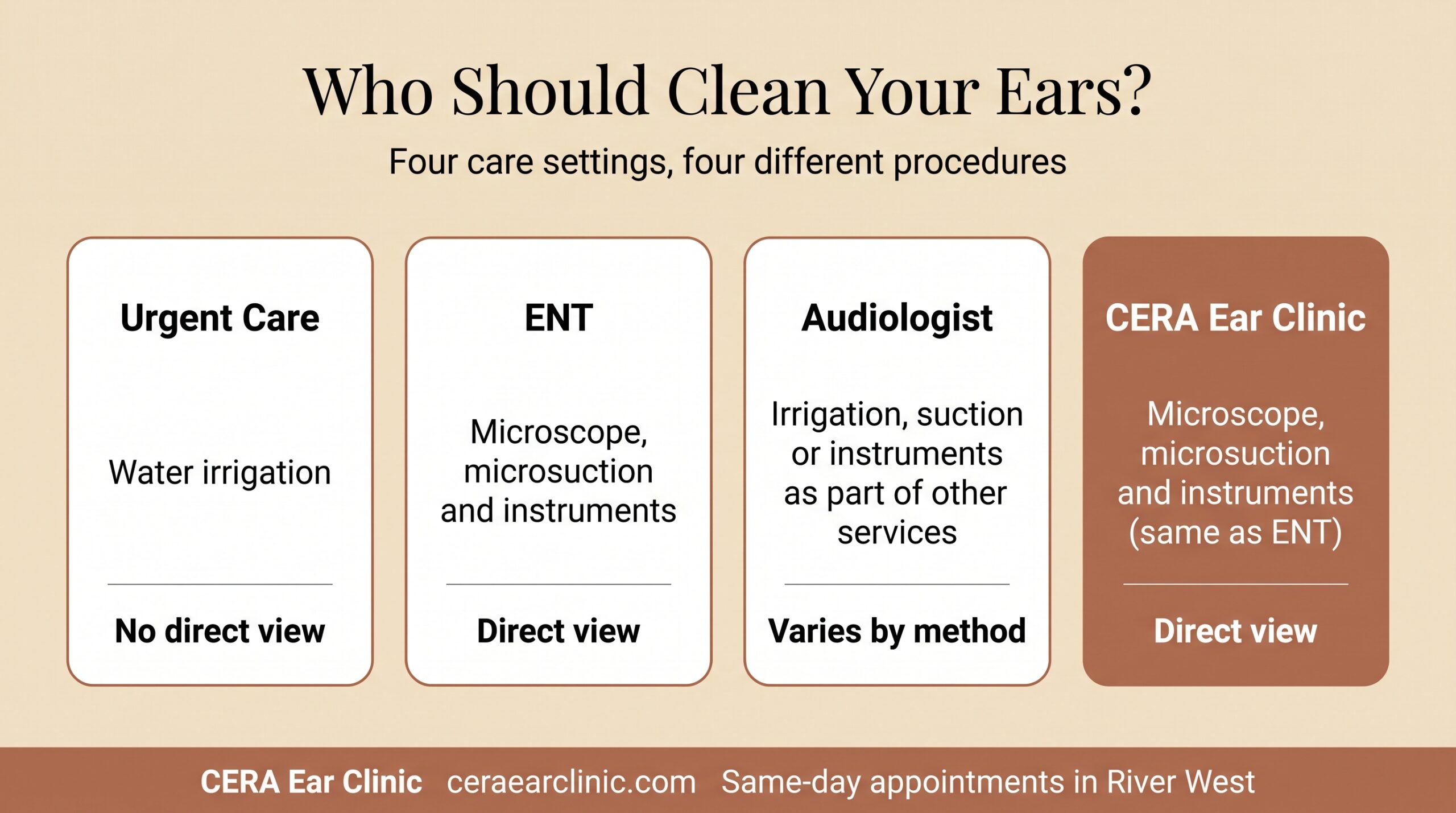
Why the place you choose decides the procedure you get
The clinical guideline is unusually direct about this. The American Academy of Otolaryngology–Head and Neck Surgery’s 2017 earwax guideline lists three widely used treatments — irrigation, softening drops, and manual removal with instruments — and then notes that “the training, skill, and experience of the clinician play a significant role in the treatment option selected.”[1]
Read that as a patient. The procedure is chosen by the room you walked into, before anyone has looked at your ear.
Ear lavage — flushing the canal with water — appears on the Urgent Care Association’s published list of competencies for urgent care providers.[2] Microscopic ear work does not. This is not a knock on urgent care, which is built for breadth and covers an enormous range of complaints very well. But a clinic equipped to irrigate will irrigate.
How safe is flushing an ear with water?
Safe most of the time. The exceptions are the point.
Irrigation is performed blind. Water is pushed into a canal the clinician cannot see into, and wax is flushed out without anyone watching it happen. The guideline puts the consequence plainly: tympanic membrane perforation, ear canal laceration, infection, bleeding or hearing loss occurs at a rate of about 1 in 1,000 ear irrigations — which it estimates at roughly 8,000 complications a year in the United States.[1]
The same guideline urges particular caution about irrigation for patients with diabetes, immunocompromise or anticoagulant use, advises against it after ear surgery, and names manual removal as the preferred technique when a perforated eardrum is suspected.[1] American Family Physician is more specific still: microscope-assisted mechanical removal is preferred where there is a perforated eardrum or a patent tympanostomy tube.[3] Every one of those cautions comes back to the same thing: it is hard to avoid injuring something you cannot see.
I see the other side of that number in clinic. Patients arrive here with canals that are further impacted or injured after a flush somewhere else.
What does microsuction actually change?
Microsuction is earwax removal performed under a binocular microscope — the same type used in ear surgery — with wax drawn out through fine suction and micro-instruments while the canal and the eardrum stay in view. If wax needs softening, that happens during the visit rather than at home beforehand. You can read the full description of how we clean ears, or a side-by-side look at the two techniques.
Nothing goes in blind, and there is no guessing about whether the canal is clear, because we are looking at it.
But the part that matters for a decision like this one is what direct visualization tells you before anything is removed. If you cannot see the eardrum, you cannot know whether it is intact. If you cannot see the canal, you cannot distinguish wax from a foreign body, from an infection, or from a canal that has been surgically altered.
That is why a genuinely four-way comparison is only writable from a clinic that can see. A provider with one procedure has one answer to give you. Being able to look is what makes it possible to tell you the answer is somebody else — and sometimes it is.
You can watch it happen, if you like. The microscope puts the whole procedure on a screen, so you can follow along in real time and see what was actually in there. And every appointment is booked for a half hour whether or not it needs one, which leaves room to look at the canal together, talk through why the wax built up, and answer whatever you want to ask about your ears and your hearing. Nobody gets moved along.
When is an ENT the right call?
We will recommend that you follow up with an otolaryngologist when your issue goes beyond just ear wax impaction.
CERA was built to give you the ENT experience without the ENT wait. We use the same microscope and the same instruments an ENT office uses, for the three things we do: ear cleanings, ear infections and foreign object removal. That includes the failed irrigations that arrive here from urgent care and elsewhere — exactly the situation the guideline has in mind when it says unsuccessful initial management should lead to “clinicians who have specialized equipment and training to clean and evaluate ear canals and tympanic membranes.”[1] Here that is usually a same-day appointment rather than a place in a queue.
The other reason to choose an ENT is simply that the wait does not bother you. Patients routinely tell us they were quoted six to eight weeks for a new-patient appointment. Referral rules can add to that: no law requires a referral to see a specialist, but HMO plans generally do and PPO plans generally do not.[4]
Can an audiologist remove ear wax?
Yes, and many do — but it is usually attached to something else.
Cerumen management sits within the audiology scope of practice nationally. The American Academy of Audiology’s scope of practice states that “audiologists may remove cerumen when necessary,” and its 2024 position statement describes the tools involved as curettes, alligator forceps, irrigation equipment and suctioning equipment.[5][6] In a 2011 survey of audiologists holding AuD degrees, 69% reported performing cerumen management, rising to 87% among those in private practice.[7]
The conditions are set by state licensure, and they vary. New York permits audiologists to remove wax only when it is necessary in order to perform audiometric test procedures.[8] Virginia’s regulation is titled “limited cerumen management” and rules it out where the eardrum is perforated or hidden behind impacted wax.[9]
For an audiologist, clearing wax is usually in service of a hearing test or a hearing aid fitting. If a hearing evaluation is what you need, that is the right door. If wax is the whole problem, you are booking a hearing evaluation in order to get a cleaning.
The four options, side by side
| Where | Typical approach | Best when | Worth knowing |
|---|---|---|---|
| Urgent care | Ear lavage — irrigation with water | You need to be seen today and nothing else is available | Irrigation is done without a view of the canal, and microscopic ear work is not part of the published urgent care competency list |
| ENT | Manual removal under a microscope, plus full diagnostic workup | Perforation, tubes, prior ear surgery, abnormal canal anatomy, or symptoms that outlast the wax | HMO plans usually require a referral, and new-patient waits are long |
| Audiologist | Irrigation, suction or instruments, as part of other services | You are having your hearing tested or hearing aids fitted | Within scope nationally, but state rules differ — some permit it only as an adjunct to audiometric testing |
| CERA Ear Clinic | Microsuction under a binocular microscope — the same microscope and instruments an ENT uses | Ear cleaning, ear infection or foreign object removal is the reason for the visit | No referral, and usually same-day |
No referral needed, and no insurance to check first. Same-day and next-day microsuction appointments are usually available in River West. Book online in about 60 seconds.
Myth: “Ear wax is ear wax — anywhere that offers removal will do.”
The guideline lists three distinct treatments: irrigation, cerumenolytic drops and manual removal with instruments. They are different procedures, not the same procedure under different branding — and which one you receive is largely settled before you arrive, by what the building owns.
Is the emergency room ever the answer?
Rarely for wax. Genuinely for a few things that feel like wax.
Impacted cerumen was the diagnosis in 3.6% of the 8.6 million US emergency room visits for ear complaints recorded between 2009 and 2011.[1] An emergency department can flush an ear, but it is the most expensive room in American medicine and it is not set up for microscopic ear work.
Go to an emergency department immediately for any of these:
- Hearing that drops suddenly in one ear, particularly overnight or over a few hours. Sudden sensorineural hearing loss is treatable, the treatment window is measured in days, and it is routinely mistaken for earwax.
- Severe ear pain, bleeding from the ear, or an injury to the ear.
- A button battery in the ear canal, at any age.
Common questions
Can my primary care doctor just do it?
Often, yes — but typically by irrigation. The guideline notes that “many primary care clinicians have the ability to irrigate cerumen in their clinics,” and pairs that capability with the alternative of removal by a specialist.[1] Microsuction needs an operating microscope and a dedicated suction unit,[10] which is not general-practice equipment, so getting microsuction usually means going to a provider set up for it. Worth asking which method your office uses before you take the appointment.
Urgent care already tried and it did not work. What now?
That is precisely the situation the guideline’s referral statement describes: unsuccessful initial management should lead to someone with specialized equipment and training.[1] Hard, long-standing wax is what water struggles with most. Irrigation generally needs several days of softening drops beforehand to have a chance at it, whereas with microsuction the softening happens during the visit, so a hard blockage is far less of an obstacle. See what impacted earwax looks like if you are not sure that is what you have.
I wear hearing aids. Where should I go?
Either, depending on what you need. Hearing aids sit in the canal and disrupt the ear’s own outward-clearing mechanism, so wearers build up wax faster. If the devices also need adjusting, see your audiologist. If it is purely a wax problem, book the cleaning directly and bring your aids with you.
Do I need a referral to come to CERA?
No. You can book directly, usually for the same or next day, and there is no medical preparation to do beforehand — just your intake forms. Here is what the appointment itself involves.
This article is for general information and does not constitute medical advice or replace an examination by a qualified clinician. Seek urgent medical attention for sudden hearing loss, severe ear pain, bleeding from the ear, or a suspected button battery in the ear canal.
References
- Schwartz SR, Magit AE, Rosenfeld RM, et al. Clinical practice guideline (update): earwax (cerumen impaction). Otolaryngology–Head and Neck Surgery. 2017;156(1_suppl):S1–S29.
- Urgent Care Association / College of Urgent Care Medicine. Urgent Care Provider Competencies.
- Michaudet C, Malaty J. Cerumen impaction: diagnosis and management. American Family Physician. 2018;98(8):525–529.
- Centers for Medicare & Medicaid Services. Health Maintenance Organization (HMO) plans; Referral, HealthCare.gov glossary.
- American Academy of Audiology. Scope of Practice. Updated April 2023.
- American Academy of Audiology. Policy Position Statement on Cerumen Management/Removal. July 2024.
- Johnson CE, Danhauer JL, Rice EN, Fisher SK. Survey of audiologists and cerumen management. American Journal of Audiology. 2013;22(1):2–13.
- New York State Education Department, Office of the Professions. Speech-Language Pathology & Audiology: law and practice.
- Virginia Administrative Code. 18VAC30-21-145, Limited cerumen management.
- Sevy JO, Hohman MH, Singh A. Cerumen impaction removal. StatPearls. StatPearls Publishing; updated 2023.